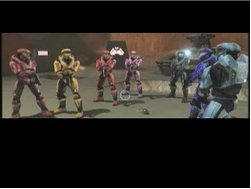
Machinima (pronounced [mə.ˈʃiː.nə.mə] or [mə.ˈʃɪ.nə.mə]), a portmanteau of machine cinema or machine animation, is both a collection of associated production techniques and a film genre defined by those techniques. As a production technique, the term concerns the rendering of computer-generated imagery (CGI) using real-time, interactive (game) 3D engines, as opposed to high-end and complex 3D animation software used by professionals. Engines from first person shooter and role-playing simulation video games are typically used. Consequently, the rendering can be done in real-time using PCs (either using the computer of the creator or the viewer), rather than with complex 3D engines using huge render farms. As a film genre, the term refers to movies created by the techniques described above.
Usually, machinima productions are produced using the tools (demo recording, camera angle, level editor, script editor, etc.) and resources (backgrounds, levels, characters, skins, etc.) available in a game. Although the topics are often based on male-oriented shooter scenarios, others have been made with romantic or dramatic topics as well.
Machinima is an example of emergent gameplay, a process of putting game tools to unexpected ends, and of artistic computer game modification. The real-time nature of machinima means that established techniques from traditional film-making can be reapplied in a virtual environment. As a result, production tends to be cheaper and more rapid than in keyframed CGI animation. It can also produce more professional appearing production than is possible with traditional at-home techniques of live video tape, or stop action using live actors, hand drawn animation or toy props.
Hacks
A hacker is often someone who likes to create and modify computer software or computer hardware, including computer programming, administration, and security-related items. A hacker is also someone who modifies electronics, for example, ham radio transceivers, printers or even home sprinkler systems to get extra functionality or performance. The term usually bears strong connotations, but may be either favorable or denigrating depending on cultural context
Video Mash Ups
The video mashup has come of age thanks to the likes of YouTube. This is where videos from multiple sources are edited together into a new video. To date, many of these video mashups have been parodies, but even music mashups are being integrated with them to make combined audio-visual mashups.
Mashup films can be broken down into several predominant styles and tropes. Most of the Mashups found on the internet fall into one category and more or less obey the unwritten rules of that class of film. These categories, are: word associated mashups, which like Danger Mouse’s “Grey Album” unite two disparate source materials by a pun or joke found in the name; transgressive mashups which transgress the sexual norms put forth in a film, often subverting hetero-normative portrayals; and overdubbing mashups, which use the images from a film and replaces the soundtrack with new dialogue or dialogue from another work, which undermines the original narrative
Audio Mash Ups
Mashup, or bootleg, is a musical genre which, in its purest form, consists of the combination (usually by digital means) of the music from one song with the a cappella from another. Typically, the music and vocals belong to completely different genres. At their best, bastard pop songs strive for musical epiphanies that add up to considerably more than the sum of their parts.
Nerd Sculpture
Nerd Sculpture is an emerging genre of Nerd Art where the artist utilizes common characters generally from video games, and creates soft sculptures of them. The sculptures generally utilize previously outdated methods of knitting, and cross-stitch to make new digital looking motifs which are not common to fabric or thread.
Nerd Painting
Nerd Paintings are paintings of classic video games, HTML code, television, and film. By painting these digital images a permanent replica of the original image is made. This negates the way one generally looks at digital media, and forces the viewer to confront the subject matter in a new and interesting light. If you haven’t noticed I make a lot of these paintings, and they are for sale too:)
Chip Music
Chiptune, or chip music, or micromusic is music written in sound formats where all the sounds are synthesized in realtime by a computer or video game console sound chip, instead of using sample-based synthesis. The "golden age" of chiptunes was the mid 1980s to early 1990s, when such sound chips were the most common method for creating music on computers. The restrictions the medium posed forced composers to become very creative when developing their own "electronic sounds". This is due to the early computer sound chips having only simple tone and noise generators imposing limitations on the complexity of the sound. The resultant chiptunes sometimes seem "harsh" or "squeaky" to the unaccustomed listener. Chiptunes are closely related to video game music. The term has also be recently applied to more recent compositions that attempt to recreate the chiptune sound, albeit with more complex technology.
Nerdcore Hip Hop
Nerdcore hip hop, or geeksta rap, is a subgenre of hip hop music that is performed by nerds or geeks, and is characterized by themes and subject matter considered to be of general interest to nerds. Self-described nerdcore musician MC Frontalot coined the term in 2000 in the song "Nerdcore Hiphop". Frontalot, like most nerdcore artists, self-publishes his work and has released much of it for free online. As a niche genre, nerdcore generally holds to the DIY ethic, and has a strong amateur tradition of self-publishing and self-production. The only things required to enter the nerdcore community are a microphone, a computer, and a webserver. No recognized nerdcore albums have ever been released on a major record label, and MP3s, not CDs, are the primary means of distribution
Science Fiction
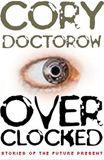
In the spirit of releasing works of art online for free. There are a handful of writers who release their entire books for download for free. This spits in the face of those who believe that downloading, and file sharing are hurting the major corporations that control them. Instead it has been shown to do just the opposite. Making works available for free on the internet expands readership, and creates a buzz around the book. Not to mention the fact that if an item is free, one will get tons of free links to your website. Cory Doctrow of Boingboing.net is the most well known science fiction writer who releases his work for absolutely nothing online.
Politics
There are many various political struggles which face the online community. One of the most popular was the issue of Net Neutrality. Basically the major telecommunications companies wanted to choke the internet, and privatize it, thus making much of it unavailable. Thankfully a grassroots surge of bloggers, and activists put an end to this but the issue has not yet gone away. Another issue which faces a lot of Nerd Artists are copyright issues since much of their work has been appropriated from mass media. I believe that if we have to watch it, or listen to it, we have the right to react to what we see or hear just as many other artists throughout the years have done.
Electronic Frontier Foundation
The Electronic Frontier Foundation (EFF) is a non-profit advocacy and legal organization based in the United States with the stated purpose of being dedicated to preserving free speech rights such as those protected by the First Amendment to the United States Constitution in the context of today's digital age. Its stated main goal is to educate the press, policymakers and the general public about civil liberties issues related to technology; and to act as a defender of those liberties. The EFF is a membership organization supported by donations and is based in San Francisco, California, with staff members in Toronto, Ontario and Washington, D.C
Robots
For many years now scientists have been making large moving robotic sculptures. While many would say that these objects are being designed for more practical purposes I would propose that many are being made just to be made. Robots for Robots sake. A perfect blend of aesthetics and science
Street Art
There are many different ways that nerd artists have taken their work directly to the streets. These can be anything from stickers, stencils, to led graffiti, to the laser graffiti which was breathtakingly created by the Graffiti Research Laboratories in the Netherlands. I love walking around Prague and seeing the new creative ways that nerdy street teams get their message out to the public in the most straightforward way possible.
Vintage Computers / Classic Video Games
Many Nerd Artists have a general affinity for vintage computers and classic video games. This could be due to the fact that many who are now creating art around this subject matter grew up on these systems, and games. The first generation of gamers and computer users need to find ways to immortalize the digital era in traditional formats. Among the most popular are the Commodore 64 computer as well as Atari, and NES 8 bit games.
Ludology
Like most academic fields, those who study video games often have differing approaches. While scholars use many different theoretical and research frameworks, the two most visible approaches are ludology and narratology.
The term ludology arose within the context of non-electronic games and board games in particular, but gained popularity after it was featured in an article by Gonzalo Frasca in 1999.[1] The name, however, has not yet caught on fully. Major issues being grappled with in the field are questions of narrative and of simulation, and whether or not video games are either, neither, or both.
The narrativists approach video games in the context of what Janet Murray calls "Cyberdrama." That is to say, their major concern is with video games as a storytelling medium, one that arises out of interactive fiction. Murray puts video games in the context of the Holodeck, a fictional piece of technology from Star Trek, arguing for the video game as a medium in which we get to become another person, and to act out in another world.[2] This image of video games certainly recieved early widespread popular support, and forms the basis of films such as Tron, eXistenZ, and The Last Starfighter. But it is also criticized by many academics (such as Espen J. Aarseth) for being better suited to some linear science fiction movies than to analysis of interactive video games with multiple narratives.
AN IRONIC DREAM OF A COMMON LANGUAGE FOR WOMEN IN THE INTEGRATED CIRCUIT
This chapter is an effort to build an ironic political myth faithful to feminism, socialism, and materialism. Perhaps more faithful as blasphemy is faithful, than as reverent worship and identification. Blasphemy has always seemed to require taking things very seriously. I know no better stance to adopt from within the secular-religious, evangelical traditions of United States politics, including the politics of socialist feminism. Blasphemy protects one from the moral majority within, while still insisting on the need for community. Blasphemy is not apostasy. Irony is about contradictions that do not resolve into larger wholes, even dialectically, about the tension of holding incompatible things together because both or all are necessary and true. Irony is about humour and serious play. It is also a rhetorical strategy and a political method, one I would like to see more honoured within socialist-feminism. At the centre of my ironic faith, my blasphemy, is the image of the cyborg.
Rob Hubbard (born 1956, Kingston upon Hull, England), is a music composer best known for his composition of computer game theme music, especially for microcomputers of the 1980s such as the Commodore 64. His work showed the real potential of both the Commodore 64's sound hardware and the ability of good music to improve the gaming experience.
In the late seventies, before scoring games, he was a professional studio musician. He decided to teach himself BASIC and machine code for the Commodore 64.
Writing a few demos and some educational software for learning music, he approached Gremlin Graphics in 1985 with samples of his work, to attempt to market his software. Gremlin were more interested in the tunes than the software and he was asked to create the soundtrack for Thing on a Spring, a platform game. Hubbard created a theme that mixed violins, electric guitars, and amusing basslines.
Hubbard went on to write or convert themes for games such as Monty on the Run, Crazy Comets, Master of Magic and Commando. Some of his most famous tunes include also Thrust, Spellbound, Sanxion, Auf Wiedersehen Monty and Ricochet. The game Knucklebusters includes Hubbard's longest tune that is 17 minutes long.
After working for several different companies, in 1989 he left Newcastle to work for Electronic Arts in America as a composer. He was the first person devoted to sound and music at EA, and did everything from low-level programming to composing. He became Audio Technical Director, a more administrative job, involving deciding which technologies to use in the games, and which to develop further. After Commodore 64 period he wrote some soundtracks for PC -games and Sega Megadrive/Genesis. His most famous post-C64 work is probably soundtrack for Skate or Die game in which he emulates distorted guitar sound with AdLib soundcard (Amiga conversion with actual guitar samples is probably not made by Hubbard).
Hubbard recently contributed a few re-arrangements of his themes to Chris Abbott's Back in Time Live C64 tribute. Hubbard has performed several times with the Danish C64 cover-band PRESS PLAY ON TAPE who have covered many of his early tunes using a full rock-band arrangement. Hubbard has also performed his old music on piano with the support of violinist madfiddler.
In 2005, music from International Karate was performed live by a full orchestra at the third Symphonic Game Music Concert. The event took place in Leipzig, Germany. Hubbard arranged and orchestrated the piece.
Hubbard left EA in 2002 and returned to England. He has recently resumed playing in a band, and has even revisited his past game music work in concert. Recent composition jobs have included music for mobile phone games. His original SID music can be found from The High Voltage SID Collection.
R.U.R. (Rossum's Universal Robots) is a science fiction play by Karel Čapek. It premiered in 1921 and is famous for having introduced and popularized the term robot.
The play begins in a factory that makes 'artificial people' - they are called Robots, but are closer to the modern idea of androids or even clones, creatures who can be mistaken for humans. They can plainly think for themselves, though they seem happy to serve. At issue is whether the "Robots" are being exploited and, if so, what follows?
The play premiered in Prague in 1921. It was translated from Czech into English by Paul Selver, and adapted for the English stage by Nigel Playfair in 1923. Basil Dean produced it in April 1923 for the Reandean Company at St. Martin's Theatre, London.
After having finished the manuscript, Čapek realized that he had created a modern version of the old Golem legend. He later took a different approach to the same theme in War with the Newts, in which non-humans become a servant class in human society.
R.U.R is dark, but not hopeless, and was successful in its day in both Europe and the United States.
A more modern (1990) translation in English is available in Toward the Radical Center: A Karel Čapek Reader, published by Catbird Press.
In February 1938, a thirty-five minute adaptation of a section of the play was broadcast on BBC Television—the first piece of television science-fiction ever to be produced. In 1948, another adaptation - this time of the entire play and running to ninety minutes - was screened by the BBC, and in between in 1941 BBC radio had also produced a radio play version. None of these three productions survive in the BBC's archives.
The Hollywood Theater of the Ear dramatized an unabridged audio version of R.U.R. which is available on the collection 2000x: Tales of the Next Millenia
The play introduced the word Robot, which displaced older words such as "automaton" or "android" in languages around the world. (In an article in Lidové noviny, Karel Čapek named his brother Josef as the true inventor of the word.) It is noteworthy that, in Čapek's text, "Robot" is always capitalized, which suggests that Čapek envisioned them to be a distinct race of nationality in the world of his play. In its original Czech, robota means drudgery or servitude. The name Rossum is an allusion to the Czech word rozum, meaning "reason", "wisdom", or "intellect". (It has been suggested that the allusion might be preserved by translating "Rossum" as "Reason", but all published translations to date have left the name untouched.)
"I think one of the changes of our consciousness of how things come into being, of how things are made and how they work...is the change from an engineering paradigm, which is to say a design paradigm, to a biological paradigm, which is a cultural and evolutionary one. In lots and lots of areas now, people say, How do you create the conditions at the bottom to allow the growth of the things you want to happen?" --Brian Eno
Back in 2002 the Walker Art Center held an exhibition entitled "Transforming Play:Family ALbums, and Monster Movies"
Espen J. Aarseth (born 1965) is a major figure in the emerging field of video game studies. He is one of the most prominent figures among what are called the "ludologists," a group of thinkers characterized by their insistence on treating video games not as a form of narrative or as a text, but instead simply as games, with the dynamics of play and interaction being the most important and fundamental part of the games.
The ludologists are contrasted by the so-called "narrativists" such as Janet Murray and Henry Jenkins.
In another opinion, the dualism ludology-narratology is quite artificial. Ludology does not exclude the so-called "narratology". See Gonzalo Frasca's article "Ludologists love stories, too: notes from a debate that never took place".
Aarseth's works include groundbreaking Cybertext: Perspectives on Ergodic Literature (Johns Hopkins UP 1997) book, which was originally his doctoral thesis. The book introduces the concept of ergodic literature, which is a text that requires non-trivial effort to be traversed. The book also contains a well-known (pre-ludological) theory, "typology of cybertext" which allows ergodic texts to be classified by their functional qualities. (In Aarseth's later work with Solveig Smedstad & Lise Sunnanå this typology of cybertext transforms into "a multi-dimensional typology of games", published in the book Level Up conference proceedings 2003 (eds. Copier & Raessens, Utrecht University & Digra)).
Aarseth was born in Bergen, Norway, and completed his doctorate at the Department of Comparative Literature at the University of Bergen. He co-founded the Department of Humanistic Informatics at the University of Bergen, and worked there until 2003, at which time he was a full professor. He is currently Principal Researcher at the Center of Computer Games Research at the IT University of Copenhagen
The major networks are starting to get in on the re-cut game. While I do think this is a hilarious re-cut of Mel Gibson's film Apocalyptico, I also fear that the mainstreaming of what are now some of the more underground nerd arts will be watered down. With that aside this SNL recut brought the genre to a huge audience. Expect more to follow.
Generative art refers to art that has been generated, composed, or constructed in an algorithmic manner through the use of systems defined by computer software algorithms, or similar mathematical or mechanical or randomised autonomous processes.
Generative art is a system oriented art practice where the common denominator is the use of systems as a production method. To meet the definition of generative art, an artwork must be self-contained and operate with some degree of autonomy. The workings of systems in generative art might resemble, or rely on, various scientific theories such as Complexity science and Information theory. The systems of generative artworks have many similarities with systems found in various areas of science. Such systems may exhibit order and/or disorder, as well as a varying degree of complexity, making behavioral prediction difficult. However, such systems still contain a defined relationship between cause and effect. Wolfgang Amadeus Mozart's "Musikalisches Würfelspiel" (Musical Dice Game) 1757 is an early example of a generative system based on randomness. The structure was based on an element of order on one hand, and disorder on the other.
An artist or creator will usually set down certain ground-rules or formulae and/or templates materials, and will then set a random or semi-random process to work on those elements. The results will remain somewhat within set limits, but may also be subject to subtle or even startling mutations. The idea of putting the art making process in the place of a pre-generated artwork is a key feature in generative art, highlighting the process-orientation as an essential characteristic. Generative artists such as Hans Haacke have explored processes of physical and biological systems in artistic context.
Generative art can also evolve in real-time, by applying feedback and generative processes to its own created states. A generative work of art would in this case never be seen to play in the same way twice. Different types of graphical programming environments (e.g. Max/Msp, Pure Data) are used in real-time for generative audiovisual artistic expressions for instance in the Demoscene and in VJ-culture.
Artificial intelligence and automated behavior have introduced new ways of seeing generative art. The term behavior is particularly useful when describing generative qualities in art because of the associations to biology and evolution, for example with the virus models used by the digital artist Joseph Nechvatal. Autopoiesis by Ken Rinaldo includes fifteen musical and robotic sculptures that interact with the public and modify their behaviors based on both the presence of the participants and each other.
The term generative art is not describing any art-movement or ideology. It's a method of making art. The term refers to how the art is made, and not taking into account why it was made or what the content of the artwork is.
The word "nerd" first appeared in Dr. Seuss's book If I Ran the Zoo[1], published in 1950, where it simply names one of Seuss's many comical imaginary animals. (The narrator Gerald McGrew claims that he would collect "a Nerkle, a Nerd, and a Seersucker too" for his imaginary zoo.)
The use of the "nerd" as slang goes back at least to 1951, when it was reported as a relatively new usage in Detroit, Michigan first by Newsweek[2] and then the St. Joseph, Michigan, Herald-Press[3]. By the early 1960s, usage of the term spread through the United States[4] and as far as Scotland[5]. Throughout this first decade, the definition was consistent—a dull person, a synonym of "square", "drip" and "scurve". During the next decade, it took on connotations of bookishness as well as social ineptitude, and the spelling "nurd" began to appear. The University of South Dakota's journal, Current Slang, contains four entries for "nurd" and one for "nerd" in 1970 and 1971. [6][7][8]
The first recorded use of the "nurd" spelling appeared in 1965, in the Rensselaer Polytechnic Institute (RPI) Bachelor[9]. Oral tradition at RPI holds that the word was coined there, spelled as "knurd" ("drunk" spelled backwards), to describe those who studied rather than partied. This usage predates a similar coinage of "knurd" by author Terry Pratchett, but has not been documented prior to the "nurd" spelling in 1965.
Other theories of the word's origin include a variation on Mortimer Snerd, the name of Edgar Bergen's ventriloquist dummy and the Northern Electric Research and Development labs in Ontario, suggesting images of engineers wearing pocket protectors with the acronym N.E.R.D. printed on them, and a claim by Philip K. Dick to having coined "nurd".[10] The term itself was used heavily in the American 1974 – 1984 television comedy Happy Days which was set in Milwaukee, Wisconsin in the mid-1950s.
The Online Etymology Dictionary speculates that the word is an alteration of a 1940s term nert meaning "stupid or crazy person," itself an alteration of nut.
The TurboGrafx-16, known as PC-Engine in Japan, is a video game console first released in Japan by NEC on October 30, 1987. The system was released in late August 1989 in North America. There was no official PAL version of the system, but a grey importer provided a very limited release in the UK and continental Europe in 1990 as Turbografx (not including the "16" in the title, and lowercase "g" in "grafx") [1].
The TurboGrafx-16 was an 8-bit system, with 16-bit graphics chip capable of displaying 482 colors at once.
Although touted and marketed at the time as a next generation "16-bit" console, in actuality the TurboGrafx-16 had only an 8-bit CPU (16-bit referred to its video graphics chip). While sporting advanced graphics and sound capabilities above and beyond the existing 8-bit console market, it was notably underpowered compared to competing 16-bit consoles such as the Sega Genesis and especially the later Super Nintendo.
Other notable feature limitations stemmed from NEC's cost cutting measures. The TurboGrafx-16 lacked a second player controller port, only supported RF modulation for audio/video (the competition had built-in support for stereo audio, and for video: composite, s-video and even RGB ouput), and even lacked basics such as a reset switch or "power-on" lighted LED indicator. While after market plug-in expansion modules did exist to provide multiple player gamepad ports and composite video-out with stereo audio, they had to be purchased separately and installed externally to the system.
This is the 2nd draft, and I plan on doing one more final draft. Please leave comments on what could be changed or improved, or what needs to be excluded or included. Subscribe if you want to be notified when the revision is released.
UPDATE: I just added this video to Mojiti where you can actually write your comments into the video itself. It is an exciting experiment in "Video 2.0". Go check it out at http://mojiti.com/kan/2024/3313 and add your voice!
Transcripts are now available as well: http://mediatedcultures.net/ksudigg/?...
A couple of people have noted that the statement, "XML was created to do just that" (separate form from content) is misleading because CSS enables the same effect with HTML. I tried to integrate CSS into the video, but it ruined the flow. Perhaps in the next draft.
My statement on XML is based on the following from xml.com: "In order to appreciate XML, it is important to understand why it was created. XML was created so that richly structured documents could be used over the web. The only viable alternatives, HTML and SGML, are not practical for this purpose. HTML, as we've already discussed, comes bound with a set of semantics and does not provide arbitrary structure."
Thank you all for the comments. With your help the next draft will be cleaned up and hopefully free of factual errors.
A higher quality version is available for download here: mediafire Please note that this is the second draft and the final version will not be available until late February after I review all comments and revise the video. Please return for a new download link at that time.
The song is "There's Nothing Impossible" by Deus, available for free at jamendo.com Deus offers music under a Creative Commons Attribution-NonCommercial-ShareAlike 2.0 license, yet one more example of the interlinking of people sharing and collaborating this video is attempting to illustrate.
CC: http://creativecommons.org/licenses/b...
Michael Wesch Assistant Professor of Cultural Anthropology Kansas State University (more) (less)
Large Archive of Free Downloadable Science Fiction EBooks
Baen Books is now making available — for free — a number of its titles in electronic format. We're calling it the Baen Free Library. Anyone who wishes can read these titles online — no conditions, no strings attached. (Later we may ask for an extremely simple, name & email only, registration. ) Or, if you prefer, you can download the books in one of several formats. Again, with no conditions or strings attached. (URLs to sites which offer the readers for these format are also listed. )
Why are we doing this? Well, for two reasons.
The first is what you might call a "matter of principle." This all started as a byproduct of an online "virtual brawl" I got into with a number of people, some of them professional SF authors, over the issue of online piracy of copyrighted works and what to do about it.
There was a school of thought, which seemed to be picking up steam, that the way to handle the problem was with handcuffs and brass knucks. Enforcement! Regulation! New regulations! Tighter regulations! All out for the campaign against piracy! No quarter! Build more prisons! Harsher sentences!
Bryce Case, Jr. (b. August 23, 1982), otherwise known as YTCracker (pronounced “whitey cracker”), is a rapper, former hacker, and Internet entrepreneur. YTCracker began producing rap music in 1998 in the genre that has since become known as nerdcore hip hop. His early work mainly focused on documenting and amusing the participants of the America Online hacking scene. YTCracker is a self-proclaimed "jack of all trades", also making a name for himself as a professional disc jockey, computer programmer, graphics designer and webmaster.
FreeJ is a vision mixer: an instrument for realtime video manipulation used in the fields of dance teather, veejaying, medical visualisation and TV.
With FreeJ multiple layers can be filtered thru effect chains and then mixed together. The supported layer inputs are images, movies, live cameras, particle generators, text scrollers, flash animations and more. All the resulting video mix can be shown on multiple and remote screens, encoded into a movie and streamed live to the internet.
FreeJ can be controlled locally or remotely, also from multiple places at the same time, using its slick console interface; can be automated via javascript and operated via MIDI and Joystick.
Video-game developers have long tried to integrate the sights and sounds of cinema into their games, with mixed results. So an emerging group of directors has instead turned to making stand-alone films.
These directors won't use cameras and sound studios, nor will they hire actors. Instead, they will use complex software applications designed to power video games, as well as computer-generated characters.
It's called machinima, and if all goes well for the up-and-coming development studios, it will be coming to television next year.
Machinima happened because game developers could not figure out how to bring Hollywood to the computer. For instance, innovations like live-action scenes, during which a player might watch a two-minute clip that moved the plot of the game forward but didn't allow the player to participate, brought game play to a screeching halt.
Despite the lukewarm success of the "cut scenes," developers continued to push the boundaries of gaming technology. However, the advances couldn't bridge the gap between interactive game play and passive movie viewing. But id Software's first-person shooter games -- Castle Wolfenstein 3D, Doom and Quake -- would give machinima filmmakers the tools they needed to create video-game movies.
These games, often graphically violent and highly popular, rely on a special game engine that defines the rules of environments where players will interact with each other. Engines handle everything from the artificial intelligence of computer-controlled characters to player movement and 3-D graphics.
PBS:Could you begin by explaining what a nonlinear narrative is? Are there different types of interactive stories?
Janet H. Murray responds:
Stories can be "nonlinear" or "interactive" both on and off the computer. Throughout the twentieth century we seem to be turning toward stories told from multiple intersecting points of view (like Faulkner's "The Sound and the Fury"), stories that have multiple possible outcomes (like Borges' "The Garden of Forking Paths" or the "Back to the Future" movies). The trend runs through high and low culture as my examples suggest. It has to do in part with the fact that we see our lives as more open to choice and possibility, less controlled by social convention or by what the Victorians called "Providence" than human beings have in other eras.
The computer offers new formats for such open-ended and multi-threaded stories. Hypertext stories let the reader navigate through segments of the tale, following different characters through the same time period or tracing different thematic connections. Interactive games and simulations allow us to replay the same situation in many different ways,observing and savoring the range of possibilities. Although most of these games are focused on battles or clever puzzle-solving, as they absorb more cinematic techniques they are increasingly plot-oriented and less concerned with winning and losing, and they are beginning to be populated with characters who are not just adversaries or puzzle-posers, but interesting in themselves.
Digital storytellers are learning how to let events unfold dramatically in worlds that have their own rules of behavior. For instance, a recent cd-rom game called "The Last Express" puts the interactor into the role of a passenger on the Orient Express railroad just before World War I, and populates the train with characters who speak different languages and walk around on their own regardless of what the protagonist chooses to do. I am charmed by the way the game lets you eavesdrop on the passengers' conversations as they talk about books or politics, in multiple languages (with some subtitles). It is a satisfying experience that goes beyond the murder and intrigue of the game-like plot, because it is imaginatively compelling to be in a fictional place and to chose which characters to pay attention to as the story unfolds.
A re-cut trailer, or retrailer is a parody trailer for a movie created by editing footage from that movie or from its original trailers, and thus are a form of mashup. They generally derive humor from misrepresenting the original film: for instance, a film with a murderous plot is made to look like a comedy, or vice versa. They became popular on the Internet in 2005.
Carnivore, by the Radical Software Group, is an artistic parody of the wire tapping application of the same name (Carnivore (FBI)), created by the FBI. The artistic version is an application with server-client architecture; several artists have created client applications for this project.
From their website:
"Carnivore is a surveillance tool for data networks. At the heart of the project is CarnivorePE, a software application that listens to all Internet traffic (email, web surfing, etc.) on a specific local network. Next, CarnivorePE serves this data stream to interfaces called "clients." These clients are designed to animate, diagnose, or interpret the network traffic in various ways. Use CarnivorePE to run Carnivore clients from your own desktop, or use it to make your own clients."
Tor is a toolset for a wide range of organizations and people that want to improve their safety and security on the Internet. Using Tor can help you anonymize web browsing and publishing, instant messaging, IRC, SSH, and other applications that use the TCP protocol. Tor also provides a platform on which software developers can build new applications with built-in anonymity, safety, and privacy features.
Tor aims to defend against traffic analysis, a form of network surveillance that threatens personal anonymity and privacy, confidential business activities and relationships, and state security. Communications are bounced around a distributed network of servers called onion routers, protecting you from websites that build profiles of your interests, local eavesdroppers that read your data or learn what sites you visit, and even the onion routers themselves.
Review of the Law, Business & Policy of Community Created Content Now Available
by Mia Garlick
CC Finland project lead Herkko Hietanen has co-authored a book with Ville Oksanen and Mikko Välimäki that provides a useful overview of the law, business and policy of “community created content,” entitled (not suprisingly) “Community Created Content. It is published by Turre Legal Publishing and available for download as a PDF under the Creative Commons Attribution-NonCommercial-NoDerivatives 2.5 license or for sale through Amazon. The book looks at different legal issues that arise in relation to conten and reviews the CC licenses, the FDL, Free Art License and FreeBSD Documentation license before turning to issues of community, business and policy.
Great science fiction radio plays, open licensed and free for downloading My pal hugh Spenser is a hell of a science fiction writer, and he's got a passion for the golden age of science fiction radio dramas. He wrote a six-part series of radio plays about the early days of science fiction fandom, which were produced by the wonderful Shoestring Theater and aired last summer on NPR. Hugh and Shoestring have released all six epiisodes as MP3s under a Creative Commons license that allows for the noncommercial redistribution. via BoingBoing
Ken Leavitt-Lawrence, known as MC Hawking, is a nerdcore hip hop artist who parodies gangster rap and theoretical physicist Stephen W. Hawking. MC Hawking gained some popularity in the early 2000s, largely due to the availability of his music on the Internet. Each of his raps are synthesized by the now defunct commercial text-to-speech program WillowTalk. The songs were originally released in MP3 format, but due to the popularity of the website, MC Hawking got a record deal with Brash Music to release a so-called "greatest hits" album. Link
Gary Gilbertson was a music composer for the Atari 8-bit family of home computers. His music made use of the AMP engine for the Atari POKEY chip which was programmed by Philip Price. Together, the two of them started a development company called Paradise Programming.
Gary saw games as an audio-visual experience and thus thought that music was an important part of a game, so he tried to make the sound as memorable as possible. Gary was lucky to have been given a much better music handler (the AMP engine) than other contemporary musicians at the time, and he made good use of it. When Paradise Programming was demoing The Tail of Beta Lyrae, Atari was so impressed that they asked him to look them up when it was completed, and also asked if they could show his music disk around. Datamost also asked Gary if they could use his music to set off their display.
Eddo Stern - Reviews: New York ArtForum, Jan, 2003 by Tim Griffin
POSTMASTERS
Among the more provocative essays published after September II was Slavoj Zizek's "Welcome to the Desert of the Real," which suggested that Americans would have to renegotiate their relationship with spectacular culture after Al Qaeda attacks forced the rupture of our seamless, unbearably light, endlessly entrancing mediascape. Whatever has happened along these lines in mass culture, it's worth asking whether any such shift has taken place in New York art production, particularly in pieces most obviously inflected by today's agitated political climate. For example, Thomas Hirschhorn's stunning installation at Barbara Gladstone Gallery might suggest the answer is no. The Swiss artist's massive cave made of wood and duct tape kept to seductive blueprints belonging to installations of the '90s boom: a low-tech, narrative style, mapping, in part, contemporary politics onto an immersive environment with spectacular architectural roots. On the other end of the spectrum, Saint Petersburg-based Sergei Bugaev Afrika's concurrent installation at I-20 seemed discomfitingly real, incorporating into a sculptural installation a video made by Al Qaeda-backed Chechen rebels of an attack on Russian soldiers.
Perhaps most poignant in this context was Eddo Stern's Sheik Attack, 2000. A former Israeli soldier, Stern spliced together selections from the video games Settlers III, SumCity, Nuclear Strike, and Red Alert to compose a "fictional documentary" about the creation, scuttled idealism, and increasing militarism of his homeland. The projected sequence of short vignettes, linked by graphics that make each scene clear as a historical phase (or a different "level" in a game), provides visual metaphors for real events. In opening scenes, for instance, construction workers erect a single building in an empty landscape, representing the nation's folk origins; later, a seemingly boundless cityscape signifies a burgeoning Tel Aviv. Yet nothing is now so intuitively correct about the piece as its episodes circling violence. One gorgeous scene depicts a single assault helicopter lifting off the desert floor before drifting behind a dune; Stern incorporates cinematic dissolves to underscore the poetry of the machine's turn ing blades. In the final moments we're presented with cold-blooded shootings in a domestic habitat. Nearly all these scenes are accompanied by nostalgic Israeli songs, whose slow, languorous phrasings create the kind of paradoxical, aestheticized violence familiar from John Woo films.