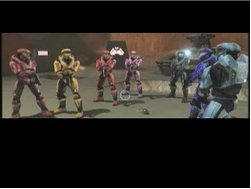
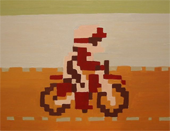
Machinima (pronounced [mə.ˈʃiː.nə.mə] or [mə.ˈʃɪ.nə.mə]), a portmanteau of machine cinema or machine animation, is both a collection of associated production techniques and a film genre defined by those techniques. As a production technique, the term concerns the rendering of computer-generated imagery (CGI) using real-time, interactive (game) 3D engines, as opposed to high-end and complex 3D animation software used by professionals. Engines from first person shooter and role-playing simulation video games are typically used. Consequently, the rendering can be done in real-time using PCs (either using the computer of the creator or the viewer), rather than with complex 3D engines using huge render farms. As a film genre, the term refers to movies created by the techniques described above.
Usually, machinima productions are produced using the tools (demo recording, camera angle, level editor, script editor, etc.) and resources (backgrounds, levels, characters, skins, etc.) available in a game. Although the topics are often based on male-oriented shooter scenarios, others have been made with romantic or dramatic topics as well.
Machinima is an example of emergent gameplay, a process of putting game tools to unexpected ends, and of artistic computer game modification. The real-time nature of machinima means that established techniques from traditional film-making can be reapplied in a virtual environment. As a result, production tends to be cheaper and more rapid than in keyframed CGI animation. It can also produce more professional appearing production than is possible with traditional at-home techniques of live video tape, or stop action using live actors, hand drawn animation or toy props.
Hacks
A hacker is often someone who likes to create and modify computer software or computer hardware, including computer programming, administration, and security-related items. A hacker is also someone who modifies electronics, for example, ham radio transceivers, printers or even home sprinkler systems to get extra functionality or performance. The term usually bears strong connotations, but may be either favorable or denigrating depending on cultural context
Video Mash Ups
The video mashup has come of age thanks to the likes of YouTube. This is where videos from multiple sources are edited together into a new video. To date, many of these video mashups have been parodies, but even music mashups are being integrated with them to make combined audio-visual mashups.
Mashup films can be broken down into several predominant styles and tropes. Most of the Mashups found on the internet fall into one category and more or less obey the unwritten rules of that class of film. These categories, are: word associated mashups, which like Danger Mouse’s “Grey Album” unite two disparate source materials by a pun or joke found in the name; transgressive mashups which transgress the sexual norms put forth in a film, often subverting hetero-normative portrayals; and overdubbing mashups, which use the images from a film and replaces the soundtrack with new dialogue or dialogue from another work, which undermines the original narrative
Audio Mash Ups
Mashup, or bootleg, is a musical genre which, in its purest form, consists of the combination (usually by digital means) of the music from one song with the a cappella from another. Typically, the music and vocals belong to completely different genres. At their best, bastard pop songs strive for musical epiphanies that add up to considerably more than the sum of their parts.
Nerd Sculpture
Nerd Sculpture is an emerging genre of Nerd Art where the artist utilizes common characters generally from video games, and creates soft sculptures of them. The sculptures generally utilize previously outdated methods of knitting, and cross-stitch to make new digital looking motifs which are not common to fabric or thread.
Nerd Painting
Nerd Paintings are paintings of classic video games, HTML code, television, and film. By painting these digital images a permanent replica of the original image is made. This negates the way one generally looks at digital media, and forces the viewer to confront the subject matter in a new and interesting light. If you haven’t noticed I make a lot of these paintings, and they are for sale too:)
Chip Music
Chiptune, or chip music, or micromusic is music written in sound formats where all the sounds are synthesized in realtime by a computer or video game console sound chip, instead of using sample-based synthesis. The "golden age" of chiptunes was the mid 1980s to early 1990s, when such sound chips were the most common method for creating music on computers. The restrictions the medium posed forced composers to become very creative when developing their own "electronic sounds". This is due to the early computer sound chips having only simple tone and noise generators imposing limitations on the complexity of the sound. The resultant chiptunes sometimes seem "harsh" or "squeaky" to the unaccustomed listener. Chiptunes are closely related to video game music. The term has also be recently applied to more recent compositions that attempt to recreate the chiptune sound, albeit with more complex technology.
Nerdcore Hip Hop
Nerdcore hip hop, or geeksta rap, is a subgenre of hip hop music that is performed by nerds or geeks, and is characterized by themes and subject matter considered to be of general interest to nerds. Self-described nerdcore musician MC Frontalot coined the term in 2000 in the song "Nerdcore Hiphop". Frontalot, like most nerdcore artists, self-publishes his work and has released much of it for free online. As a niche genre, nerdcore generally holds to the DIY ethic, and has a strong amateur tradition of self-publishing and self-production. The only things required to enter the nerdcore community are a microphone, a computer, and a webserver. No recognized nerdcore albums have ever been released on a major record label, and MP3s, not CDs, are the primary means of distribution
Science Fiction
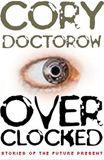
In the spirit of releasing works of art online for free. There are a handful of writers who release their entire books for download for free. This spits in the face of those who believe that downloading, and file sharing are hurting the major corporations that control them. Instead it has been shown to do just the opposite. Making works available for free on the internet expands readership, and creates a buzz around the book. Not to mention the fact that if an item is free, one will get tons of free links to your website. Cory Doctrow of Boingboing.net is the most well known science fiction writer who releases his work for absolutely nothing online.
Politics
There are many various political struggles which face the online community. One of the most popular was the issue of Net Neutrality. Basically the major telecommunications companies wanted to choke the internet, and privatize it, thus making much of it unavailable. Thankfully a grassroots surge of bloggers, and activists put an end to this but the issue has not yet gone away. Another issue which faces a lot of Nerd Artists are copyright issues since much of their work has been appropriated from mass media. I believe that if we have to watch it, or listen to it, we have the right to react to what we see or hear just as many other artists throughout the years have done.
Electronic Frontier Foundation
The Electronic Frontier Foundation (EFF) is a non-profit advocacy and legal organization based in the United States with the stated purpose of being dedicated to preserving free speech rights such as those protected by the First Amendment to the United States Constitution in the context of today's digital age. Its stated main goal is to educate the press, policymakers and the general public about civil liberties issues related to technology; and to act as a defender of those liberties. The EFF is a membership organization supported by donations and is based in San Francisco, California, with staff members in Toronto, Ontario and Washington, D.C
Robots
For many years now scientists have been making large moving robotic sculptures. While many would say that these objects are being designed for more practical purposes I would propose that many are being made just to be made. Robots for Robots sake. A perfect blend of aesthetics and science
Street Art
There are many different ways that nerd artists have taken their work directly to the streets. These can be anything from stickers, stencils, to led graffiti, to the laser graffiti which was breathtakingly created by the Graffiti Research Laboratories in the Netherlands. I love walking around Prague and seeing the new creative ways that nerdy street teams get their message out to the public in the most straightforward way possible.
Vintage Computers / Classic Video Games
Many Nerd Artists have a general affinity for vintage computers and classic video games. This could be due to the fact that many who are now creating art around this subject matter grew up on these systems, and games. The first generation of gamers and computer users need to find ways to immortalize the digital era in traditional formats. Among the most popular are the Commodore 64 computer as well as Atari, and NES 8 bit games.
Ludology
Like most academic fields, those who study video games often have differing approaches. While scholars use many different theoretical and research frameworks, the two most visible approaches are ludology and narratology.
The term ludology arose within the context of non-electronic games and board games in particular, but gained popularity after it was featured in an article by Gonzalo Frasca in 1999.[1] The name, however, has not yet caught on fully. Major issues being grappled with in the field are questions of narrative and of simulation, and whether or not video games are either, neither, or both.
The narrativists approach video games in the context of what Janet Murray calls "Cyberdrama." That is to say, their major concern is with video games as a storytelling medium, one that arises out of interactive fiction. Murray puts video games in the context of the Holodeck, a fictional piece of technology from Star Trek, arguing for the video game as a medium in which we get to become another person, and to act out in another world.[2] This image of video games certainly recieved early widespread popular support, and forms the basis of films such as Tron, eXistenZ, and The Last Starfighter. But it is also criticized by many academics (such as Espen J. Aarseth) for being better suited to some linear science fiction movies than to analysis of interactive video games with multiple narratives.
The Telegarden is a system that allows a living garden tended by a robot manipulator to be operated via anyone on the WWW with a desktop (or laptop!) computer and modem. We had three major objectives in constructing it.
1 To integrate natural, organic elements with robots, so that some parts were fixed and others would grow, change and decay; 2 To create a work of art in the interplay of natural beauty and technology, and 3 As an experiment in electronic community where web surfers can gather and interact amongst themselves and with a real environment.
McLeod Mirror Series 1: See Yourself in Others are not actually made of mirrored glass, but an LCD screen housed in a wooden case with a web cam attached to the top. The camera records the viewer and creates a collage of the person’s image along with images of everyone else who has stood before the mirror. The image allows the viewer to “see themselves reflected in others” in a new way. The mirrors bring a timeless bathroom product into the digital age, creating a twist on the staple that is more interesting and dynamic than the original, while perhaps pointlessly complex. The images are not recorded or archived, so the digital artwork created on the spot will never be seen again. Link
Jana Bartouskova makes these really cute little aliens, and monsters. Unfortunately she dosn't have a website where they can all be found. I wish she had a website where more of her items could be found, well, maybe I'll have to make her one, considering that she's my girlfriend:)
She made this hand with the severed for my friend who we forced to see Hostel. He wasn't very impressed with the film, so she had to immortalise it in some way.
She made me this pacman pillow for an installation I did last year. I'm posting this because I want my female readers to know that they can send in their stuff as well. There is a lot of boyliness going on here at nerdarts and I like to see both sides. I really like a lot of the stuff going on at etsy.com . So girls, feel free to send us your submissions as well!
Rey Ortega has made a great interactive book. Reminiscent of the Choose your own adventure series. You are Cagney who is transversing though a fantastical landscape, encountering monsters, and making tough decisions. The illustrations are great, and the weathered look that he gives the book make it all the more personal. I won't give anything away, you have to play/read it for yourself!
Chicago had thousands of Bulls throughout the city years ago, Buffalo NY had, well, buffaloes, and continuing the tradition of letting a large group of artists rethink a form we have a group of comic book, tattoo, and comic book artists taking their own individual stabs at Darth Vader (well, helmut mainly). Participating artists and companies included Troy Alders, Kii Arens, Attaboy, Anthony Ausgang, Axis, Aye Jay, Gary Baseman, Andrew Bell, Tim Biskup, Andrew Brandou, Buff Monster, Mister Cartoon, Mr Clement, Steven Daily, Dalek, Cam de Leon, , Bob Dob, Marc Ecko, Eelus, Ron English, FERG, David Flores, Brian Flynn - Hybrid Design, Paul Frank Sunich, Huck Gee, Fawn Gehweiler, Mike Giant, Joe Hahn, Derek Hess, Jeremyville, Sun-MinKim, David Horvath, Jim Koch, Frank Kozik, David S. Krys - DSK Designs, Peter Kuper, Wade Lageose - Lageose Design, Joe Ledbetter, Simone Legno - Tokidoki, Mad, Bill McMullen, Melvins, Brian Morris, Niagara, Mitch O'Connell, olive47, Estevan Oriol, Alex Pardee, Pizz, Plastic God, Playskewl, Dave Pressler, J. Otto Seibold, Shag, Sket-One, Shawn Smith, Winston Smith, Jeff Soto, Bwana Spoons, Jophen Stein, Suckadelic, Cameron Tiede, Touma, UrbanMedium, Michelle Valigura, VanBeater, and Amanda Visell. Link via starwars.com
A live action role-playing game (LARP or LRP) is a form of role-playing game where the participants perform some or all of the physical actions of the characters they are playing within a pre-determined space for a pre-determined span of time. LARP may be considered a form of improvisational theatre.
The two most common ways of simulating combat in LARP are through either physical representation or symbolic determination. Physical combat occurs without interruption in role-play, using "boffer" or latex representations of edged weapons, airsoft or laser tag guns, and similar. A variety of physical combat uses relatively harmless versions of real weapons (blunt steel swords, firearms loaded with blanks) rather than representations. Games using physical combat are often known as "Boffer" or "Live Combat" LARPs.
Symbolic determination relies on players momentarily suspending role-playing in order to determine the outcome of combat, for example by rolling dice, playing rock-paper-scissors or comparing character attributes. In symbolic combat systems, weapons may be represented as cards or inaccurate replicas. A "no-touch" rule, prohibiting physical contact between players, is often enforced. LARPs which feature symbolic combat may be known as free-form role-playing games or theatre-style games.
All symbolic combat systems, and most physical combat systems, use game rules governing attributes such as character strength, fighting skills and ability to endure physical pain in order to determine the outcome of a combat situation. An exception is honour system LARPs, where players are trusted to determine the outcomes of combat through free improvisation.
Physical representation is most common in, but not exclusive to, LARP styles where combat is seen as central to game-play. Conversely, symbolic determination and honour system LARPs tend to place less emphasis on combat.
Combat resolution is usually indicative of the design philosophy behind a specific LARP system. The same approaches as are taken to combat will often be used for other elements of LARP simulation such as magic, political power, character sexuality, scenery and propping. For this reason, combat resolution is the most widely used criterion for distinguishing between LARP styles.
Some LARP games involve heavy combat with boffers. Although some games have a "No-touch" policy, some other games are wildly violent in terms of weapons combat. Players of these LARP games must learn the old styles of combat in order to stand a chance in the "real" combat they intend to engage in. Practicing is often encouraged when engaging in these games due to the fact that if you don't practice, you will be beaten fairly regularly. This aspect draws many people to combat intensive LARP games because the idea of taking on a persona that is well versed in the art of sword fighting is very attractive. Link
It dosn't get much nerdarty than this. Play Pac man through the fantastic passages created by Mondrian!
"Pac-Mondrian closes the perceptual distance between fine art and video games by combining Piet Mondrian's Modernist masterpiece 'Broadway Boogie Woogie' with Toru Iwatani's classic video game Pac-Man. The two new Ms. Pac-Mondrian levels return the painting to the dance clubs that inspired it with music by contemporary techno musicians mapping the birth of electronic music in their home towns.
When Piet Mondrian arrived in New York in 1940, he heard the Boogie Woogie piano of Meade Lux Lewis, Albert Ammons, and Pete Johnson, and from then on refused to dance to any other jazz, leaving the floor in a huff if the music didn't boogie.
After years of completely abstract work he abandoned the black grid to use yellow lines and red, blue, and grey colour blocks to build a representation of New York infused with all the vibrant kinetic energy of raucous road-house piano blues in 'Broadway Boogie Woogie'.
Pac-Mondrian transcodes 'Broadway Boogie Woogie' into a Pac-Man video game: the painting becomes the board, the music becomes the sound effects, and Piet Mondrian becomes Pac-Man.
Pac-Mondrian disciplines the syncopated rhythms of Mondrian's spatial arrangements into a regular grid, then frees the gaze to follow the viewer's whimsical perambulations of the painting: a player's thorough study of the painting clears the level.
Each play of the game is an act of devotion. Mondrian's geometric spirituality fuses with his ecstatic physicality when Pac-Mondrian dances around the screen while the Trinity of Boogie Woogie jazz play 'Boogie Woogie Prayer'.
Each play of the game is an improvisational jazz session. Pac-Mondrian sits in as a session drummer with Ammons, Lewis, and Johnson, hitting hi-hats, cymbals, and snares as he eats pellets." via link
And a little background on Mondrian before you start playing:)
Pieter Cornelis (Piet) Mondriaan, after 1912 Mondrian, (pronounced: Pete Mon-dree-on, IPA: [pit 'mɔndɹiɔn]) (b. Amersfoort, Netherlands, March 7, 1872 — d. New York City, February 1, 1944) was a Dutch painter.
He was an important contributor to the De Stijl art movement and group, which was founded by Theo van Doesburg. Despite being well-known, often-parodied and even trivialized, Mondriaan's paintings exhibit a complexity that belies their apparent simplicity. He is best known for his non-representational paintings that he called "compositions", consisting of rectangular forms of red, yellow, blue, white or black, separated by black rectilinear lines. They are the result of a stylistic evolution that occurred over the course of nearly 30 years and continued beyond that point to the end of his life.
Generative art refers to art that has been generated, composed, or constructed in an algorithmic manner through the use of systems defined by computer software algorithms, or similar mathematical or mechanical or randomised autonomous processes.
Generative art is a system oriented art practice where the common denominator is the use of systems as a production method. To meet the definition of generative art, an artwork must be self-contained and operate with some degree of autonomy. The workings of systems in generative art might resemble, or rely on, various scientific theories such as Complexity science and Information theory. The systems of generative artworks have many similarities with systems found in various areas of science. Such systems may exhibit order and/or disorder, as well as a varying degree of complexity, making behavioral prediction difficult. However, such systems still contain a defined relationship between cause and effect. Wolfgang Amadeus Mozart's "Musikalisches Würfelspiel" (Musical Dice Game) 1757 is an early example of a generative system based on randomness. The structure was based on an element of order on one hand, and disorder on the other.
An artist or creator will usually set down certain ground-rules or formulae and/or templates materials, and will then set a random or semi-random process to work on those elements. The results will remain somewhat within set limits, but may also be subject to subtle or even startling mutations. The idea of putting the art making process in the place of a pre-generated artwork is a key feature in generative art, highlighting the process-orientation as an essential characteristic. Generative artists such as Hans Haacke have explored processes of physical and biological systems in artistic context.
Generative art can also evolve in real-time, by applying feedback and generative processes to its own created states. A generative work of art would in this case never be seen to play in the same way twice. Different types of graphical programming environments (e.g. Max/Msp, Pure Data) are used in real-time for generative audiovisual artistic expressions for instance in the Demoscene and in VJ-culture.
Artificial intelligence and automated behavior have introduced new ways of seeing generative art. The term behavior is particularly useful when describing generative qualities in art because of the associations to biology and evolution, for example with the virus models used by the digital artist Joseph Nechvatal. Autopoiesis by Ken Rinaldo includes fifteen musical and robotic sculptures that interact with the public and modify their behaviors based on both the presence of the participants and each other.
The term generative art is not describing any art-movement or ideology. It's a method of making art. The term refers to how the art is made, and not taking into account why it was made or what the content of the artwork is.
FreeJ is a vision mixer: an instrument for realtime video manipulation used in the fields of dance teather, veejaying, medical visualisation and TV.
With FreeJ multiple layers can be filtered thru effect chains and then mixed together. The supported layer inputs are images, movies, live cameras, particle generators, text scrollers, flash animations and more. All the resulting video mix can be shown on multiple and remote screens, encoded into a movie and streamed live to the internet.
FreeJ can be controlled locally or remotely, also from multiple places at the same time, using its slick console interface; can be automated via javascript and operated via MIDI and Joystick.
Carnivore, by the Radical Software Group, is an artistic parody of the wire tapping application of the same name (Carnivore (FBI)), created by the FBI. The artistic version is an application with server-client architecture; several artists have created client applications for this project.
From their website:
"Carnivore is a surveillance tool for data networks. At the heart of the project is CarnivorePE, a software application that listens to all Internet traffic (email, web surfing, etc.) on a specific local network. Next, CarnivorePE serves this data stream to interfaces called "clients." These clients are designed to animate, diagnose, or interpret the network traffic in various ways. Use CarnivorePE to run Carnivore clients from your own desktop, or use it to make your own clients."
Eddo Stern - Reviews: New York ArtForum, Jan, 2003 by Tim Griffin
POSTMASTERS
Among the more provocative essays published after September II was Slavoj Zizek's "Welcome to the Desert of the Real," which suggested that Americans would have to renegotiate their relationship with spectacular culture after Al Qaeda attacks forced the rupture of our seamless, unbearably light, endlessly entrancing mediascape. Whatever has happened along these lines in mass culture, it's worth asking whether any such shift has taken place in New York art production, particularly in pieces most obviously inflected by today's agitated political climate. For example, Thomas Hirschhorn's stunning installation at Barbara Gladstone Gallery might suggest the answer is no. The Swiss artist's massive cave made of wood and duct tape kept to seductive blueprints belonging to installations of the '90s boom: a low-tech, narrative style, mapping, in part, contemporary politics onto an immersive environment with spectacular architectural roots. On the other end of the spectrum, Saint Petersburg-based Sergei Bugaev Afrika's concurrent installation at I-20 seemed discomfitingly real, incorporating into a sculptural installation a video made by Al Qaeda-backed Chechen rebels of an attack on Russian soldiers.
Perhaps most poignant in this context was Eddo Stern's Sheik Attack, 2000. A former Israeli soldier, Stern spliced together selections from the video games Settlers III, SumCity, Nuclear Strike, and Red Alert to compose a "fictional documentary" about the creation, scuttled idealism, and increasing militarism of his homeland. The projected sequence of short vignettes, linked by graphics that make each scene clear as a historical phase (or a different "level" in a game), provides visual metaphors for real events. In opening scenes, for instance, construction workers erect a single building in an empty landscape, representing the nation's folk origins; later, a seemingly boundless cityscape signifies a burgeoning Tel Aviv. Yet nothing is now so intuitively correct about the piece as its episodes circling violence. One gorgeous scene depicts a single assault helicopter lifting off the desert floor before drifting behind a dune; Stern incorporates cinematic dissolves to underscore the poetry of the machine's turn ing blades. In the final moments we're presented with cold-blooded shootings in a domestic habitat. Nearly all these scenes are accompanied by nostalgic Israeli songs, whose slow, languorous phrasings create the kind of paradoxical, aestheticized violence familiar from John Woo films.