Machinima (pronounced [mə.ˈʃiː.nə.mə] or [mə.ˈʃɪ.nə.mə]), a portmanteau of machine cinema or machine animation, is both a collection of associated production techniques and a film genre defined by those techniques. As a production technique, the term concerns the rendering of computer-generated imagery (CGI) using real-time, interactive (game) 3D engines, as opposed to high-end and complex 3D animation software used by professionals. Engines from first person shooter and role-playing simulation video games are typically used. Consequently, the rendering can be done in real-time using PCs (either using the computer of the creator or the viewer), rather than with complex 3D engines using huge render farms. As a film genre, the term refers to movies created by the techniques described above.
Usually, machinima productions are produced using the tools (demo recording, camera angle, level editor, script editor, etc.) and resources (backgrounds, levels, characters, skins, etc.) available in a game. Although the topics are often based on male-oriented shooter scenarios, others have been made with romantic or dramatic topics as well.
Machinima is an example of emergent gameplay, a process of putting game tools to unexpected ends, and of artistic computer game modification. The real-time nature of machinima means that established techniques from traditional film-making can be reapplied in a virtual environment. As a result, production tends to be cheaper and more rapid than in keyframed CGI animation. It can also produce more professional appearing production than is possible with traditional at-home techniques of live video tape, or stop action using live actors, hand drawn animation or toy props.
Hacks
A hacker is often someone who likes to create and modify computer software or computer hardware, including computer programming, administration, and security-related items. A hacker is also someone who modifies electronics, for example, ham radio transceivers, printers or even home sprinkler systems to get extra functionality or performance. The term usually bears strong connotations, but may be either favorable or denigrating depending on cultural context
Video Mash Ups
The video mashup has come of age thanks to the likes of YouTube. This is where videos from multiple sources are edited together into a new video. To date, many of these video mashups have been parodies, but even music mashups are being integrated with them to make combined audio-visual mashups.
Mashup films can be broken down into several predominant styles and tropes. Most of the Mashups found on the internet fall into one category and more or less obey the unwritten rules of that class of film. These categories, are: word associated mashups, which like Danger Mouse’s “Grey Album” unite two disparate source materials by a pun or joke found in the name; transgressive mashups which transgress the sexual norms put forth in a film, often subverting hetero-normative portrayals; and overdubbing mashups, which use the images from a film and replaces the soundtrack with new dialogue or dialogue from another work, which undermines the original narrative
Audio Mash Ups
Mashup, or bootleg, is a musical genre which, in its purest form, consists of the combination (usually by digital means) of the music from one song with the a cappella from another. Typically, the music and vocals belong to completely different genres. At their best, bastard pop songs strive for musical epiphanies that add up to considerably more than the sum of their parts.
Nerd Sculpture
Nerd Sculpture is an emerging genre of Nerd Art where the artist utilizes common characters generally from video games, and creates soft sculptures of them. The sculptures generally utilize previously outdated methods of knitting, and cross-stitch to make new digital looking motifs which are not common to fabric or thread.
Nerd Painting
Nerd Paintings are paintings of classic video games, HTML code, television, and film. By painting these digital images a permanent replica of the original image is made. This negates the way one generally looks at digital media, and forces the viewer to confront the subject matter in a new and interesting light. If you haven’t noticed I make a lot of these paintings, and they are for sale too:)
Chip Music
Chiptune, or chip music, or micromusic is music written in sound formats where all the sounds are synthesized in realtime by a computer or video game console sound chip, instead of using sample-based synthesis. The "golden age" of chiptunes was the mid 1980s to early 1990s, when such sound chips were the most common method for creating music on computers. The restrictions the medium posed forced composers to become very creative when developing their own "electronic sounds". This is due to the early computer sound chips having only simple tone and noise generators imposing limitations on the complexity of the sound. The resultant chiptunes sometimes seem "harsh" or "squeaky" to the unaccustomed listener. Chiptunes are closely related to video game music. The term has also be recently applied to more recent compositions that attempt to recreate the chiptune sound, albeit with more complex technology.
Nerdcore Hip Hop
Nerdcore hip hop, or geeksta rap, is a subgenre of hip hop music that is performed by nerds or geeks, and is characterized by themes and subject matter considered to be of general interest to nerds. Self-described nerdcore musician MC Frontalot coined the term in 2000 in the song "Nerdcore Hiphop". Frontalot, like most nerdcore artists, self-publishes his work and has released much of it for free online. As a niche genre, nerdcore generally holds to the DIY ethic, and has a strong amateur tradition of self-publishing and self-production. The only things required to enter the nerdcore community are a microphone, a computer, and a webserver. No recognized nerdcore albums have ever been released on a major record label, and MP3s, not CDs, are the primary means of distribution
Science Fiction
In the spirit of releasing works of art online for free. There are a handful of writers who release their entire books for download for free. This spits in the face of those who believe that downloading, and file sharing are hurting the major corporations that control them. Instead it has been shown to do just the opposite. Making works available for free on the internet expands readership, and creates a buzz around the book. Not to mention the fact that if an item is free, one will get tons of free links to your website. Cory Doctrow of Boingboing.net is the most well known science fiction writer who releases his work for absolutely nothing online.
Politics
There are many various political struggles which face the online community. One of the most popular was the issue of Net Neutrality. Basically the major telecommunications companies wanted to choke the internet, and privatize it, thus making much of it unavailable. Thankfully a grassroots surge of bloggers, and activists put an end to this but the issue has not yet gone away. Another issue which faces a lot of Nerd Artists are copyright issues since much of their work has been appropriated from mass media. I believe that if we have to watch it, or listen to it, we have the right to react to what we see or hear just as many other artists throughout the years have done.
Electronic Frontier Foundation
The Electronic Frontier Foundation (EFF) is a non-profit advocacy and legal organization based in the United States with the stated purpose of being dedicated to preserving free speech rights such as those protected by the First Amendment to the United States Constitution in the context of today's digital age. Its stated main goal is to educate the press, policymakers and the general public about civil liberties issues related to technology; and to act as a defender of those liberties. The EFF is a membership organization supported by donations and is based in San Francisco, California, with staff members in Toronto, Ontario and Washington, D.C
Robots
For many years now scientists have been making large moving robotic sculptures. While many would say that these objects are being designed for more practical purposes I would propose that many are being made just to be made. Robots for Robots sake. A perfect blend of aesthetics and science
Street Art
There are many different ways that nerd artists have taken their work directly to the streets. These can be anything from stickers, stencils, to led graffiti, to the laser graffiti which was breathtakingly created by the Graffiti Research Laboratories in the Netherlands. I love walking around Prague and seeing the new creative ways that nerdy street teams get their message out to the public in the most straightforward way possible.
Vintage Computers / Classic Video Games
Many Nerd Artists have a general affinity for vintage computers and classic video games. This could be due to the fact that many who are now creating art around this subject matter grew up on these systems, and games. The first generation of gamers and computer users need to find ways to immortalize the digital era in traditional formats. Among the most popular are the Commodore 64 computer as well as Atari, and NES 8 bit games.
Ludology
Like most academic fields, those who study video games often have differing approaches. While scholars use many different theoretical and research frameworks, the two most visible approaches are ludology and narratology.
The term ludology arose within the context of non-electronic games and board games in particular, but gained popularity after it was featured in an article by Gonzalo Frasca in 1999.[1] The name, however, has not yet caught on fully. Major issues being grappled with in the field are questions of narrative and of simulation, and whether or not video games are either, neither, or both.
The narrativists approach video games in the context of what Janet Murray calls "Cyberdrama." That is to say, their major concern is with video games as a storytelling medium, one that arises out of interactive fiction. Murray puts video games in the context of the Holodeck, a fictional piece of technology from Star Trek, arguing for the video game as a medium in which we get to become another person, and to act out in another world.[2] This image of video games certainly recieved early widespread popular support, and forms the basis of films such as Tron, eXistenZ, and The Last Starfighter. But it is also criticized by many academics (such as Espen J. Aarseth) for being better suited to some linear science fiction movies than to analysis of interactive video games with multiple narratives.
Wired's monthly Jargon Watch feature has listed ludology as new bit jargon alongside fratire, chassis (in a non-automotive sense) and social jet lag. According to Jonathon Keats of Wired, ludology (from the latin word ludus, meaning "games") is the academic study of videogames. Intellectual sites such as Jesper Juul's The Ludologist and Gonzalo Frasca's Ludology.org consistently provide us with thought-provoking material on our favorite entertainment medium. via Joystiq
Privacy tools can sometimes create strange bedfellows.
That's what has happened with an anonymizer system that was originally developed and funded by the U.S. Naval Research Laboratory to help government employees shield their identity online. It is now being co-funded and promoted by the civil liberties group Electronic Frontier Foundation.
The system, called Tor, allows users to surf the internet, chat and send instant messages anonymously. It works by transferring traffic three times through random servers, or nodes, on its way from sender to recipient to make it difficult for anyone to trace the data back to its source.
These updates are hacks to the "about:config" menu to improve anonymity and the anonymity set by increasing the scope of the Tor HTTP/S Header template.
Search 23,500 CC tracks via audio similarity or keyword
Mike Linksvayer, January 24th, 2007
Owl Multimedia has more than doubled the number of CC licensed tracks you can search via audio similarity (sounds like a mp3 you already have) or keywords. How? By adding over 10,000 tracks from Jamendo.
Nykkyo Kyhana is a native of a planet formed when a future Earth space mission fell into a black hole and emerged thousands of years in the past. He finds himself on present-day Earth, sent on a mission to gather plants for his people's food and fibre supplies. There he befriends Sukiko, a lecturer at the university where he is assigned. As their friendship blossoms into a deep love, Nyk learns she is his own distant ancestor, as well as an ancestor to the man who founded his world. He realizes his love for her risks disrupting future events and jeopardizes his own existence and that of his people.
Nyk blames himself for such a disruption when Sukiko attempts suicide. After intervening to save her life, he decides he must disengage from her, to prevent further interference. But, by now it is too late. Events have been set into motion and Nyk is compelled to intervene again on her behalf -- or face temporal annihilation.
Seen exclusively through the eyes of a visitor from another world, Earthbound unfolds as Nyk's journey of discovery, as he learns of his past, his purpose and finds the love of his life.
It is, as the sinologist and computer poet John Cayley writes, ``difficult to say anything hard and fast in terms of more-or-less conventional criticism about a site which is hardly ever the same on successive visits.''{1} At the time of this writing, http://www.jodi.org transferred all its visitors to the download page of ``Untitled Game''. The rest of the web site could be found via World Wide Web search engines, pointing to critical writing about jodi.org which in turn pointed to its sections hidden from the front page - or by using the pirate mirror of www.jodi.org on http://www.0100101110101101.org/home/ jodi.org. Thus undermining the corporate identity contained in its catchy web address, jodi.org requires its readers to invest net-work on their own. This strategy of withdrawal also reminds of Gnosticist writings from the late antiquity which, for a long time, had only survived through citations in the writings of Christian theologists who sought to refute them. launch untitled-game
"Obviously everyone's always wanted to write their own music for the 2600. So here it is: a sort of Atari 2600 tracker. You edit music data in a text file where patterns are created and sequenced into a song. Then you assemble the music data into an Atari 2600 ROM which will play on 2600 emulators or on a real Atari 2600 using a Supercharger or Cuttle Cart.
You can use it to write backing beats or tracks for your music, or develop music for 2600 homebrew games. The driver uses a very small amount of 2600 resources so it can easily be placed into game code. There is a growing demand for 2600 homebrew music so it would be great to have more 2600 music programmers.
I've recently released version 2 of the music kit with a much more advanced driver and player. Grab the latest version below.
And 2600 music programming can be a bit difficult, so I've written a new 2600 sound and music programmer's guide which covers almost everything I know about 2600 sound and music and includes three useful sets of in-tune notes to help overcome the 2600's very limited pitch. Download below.
Note that since I only have the DOS version of DASM tested and set up, currently the kit is only set up to run out of the box on PCs. However I know that it does work on Macs using the Mactari tools and it can probably be set up on Linux too.
If you are a musician and develop songs or backing tracks using the sequencer, you will be able to have an actual cartridge made of your sequences by sending the ROM image to Atariage."
VertexList is a artist run space in Williamsburg New York with the intent of supporting emerging media artists. VertexList seeks artwork exposing the code of the post-capitalist system in both new and traditional formats. link
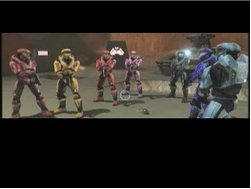
Red vs. Blue: The Blood Gulch Chronicles, often abbreviated as RvB, is a machinima comic science fiction video series created by Rooster Teeth Productions and distributed primarily through the Internet and DVD. The series chronicles the story of two opposing teams of soldiers fighting a civil war in the middle of a desolate box canyon (Blood Gulch), in a parody of first-person shooter (FPS) games, military life, and science fiction films. Initially intended to be a short series of six to eight episodes, the project quickly and unexpectedly achieved significant popularity following its April 1, 2003, Internet premiere. Rooster Teeth therefore decided to extend the series, whose fifth season premiered publicly on October 2, 2006.
Red vs. Blue emerged from Burnie Burns' voice-over-enhanced gameplay videos of Bungie Studios' FPS video game Halo: Combat Evolved. The series is primarily produced using the machinima technique of synchronizing video footage from a game to pre-recorded dialogue and other audio. Footage is mostly from the multiplayer modes of Halo: Combat Evolved and its sequel, Halo 2, on the Microsoft Xbox video game console.
Free Downloads of the first two seasons of Red Vs Blue
Plunderphonics is a term coined by John Oswald in 1985 in an essay entitled Plunderphonics, or Audio Piracy as a Compositional Prerogative. It has since been applied to any music made by taking one or more existing audio recordings and altering them in some way to make a new composition. There is no attempt to disguise the fact that the sounds making up the composition have been "borrowed" in this way, and sometimes the sounds may be taken from very familiar sources. Plunderphonics can be considered a form of sound collage.
Although the concept of plunderphonics is seemingly broad, in practice there are many common themes used in what is normally called plunderphonic music. This includes heavy sampling of educational films of the 1950s, news reports, radio shows, or anything with trained vocal announcers. Oswald's contributions to this genre rarely used these materials, the exception being his rap-like 1975 track "Power."
The process of Sampling other sources is found in various genres (notably hip-hop), but in plunderphonic works the sampled material is often the only sound used. These samples are usually uncleared, and sometimes result in legal action being taken due to copyright infringement. Some plunderphonic artists use their work to protest what they consider to be overly-restrictive copyright laws. Many plunderphonic artists claim their use of other artists' materials falls under the fair use doctrine.
Crypto-anarchism is a philosophy that expounds the use of strong public-key cryptography to enforce privacy and individual freedom. Crypto-anarchists aim to create cryptographic software that can be used to evade prosecution and harassment while sending and receiving information in computer networks.
With the help of the software mentioned the connection between the identity of a certain user or organisation and the pseudonym used is almost entirely unprovable unless the user reveals the connection. It is even difficult to say which country's laws will be ignored, as even the location (country) of a certain participant is unknown. In a sense, the encrypted anonymous networks (the "cipherspace") can be regarded as an independent, lawless territory. However, participants may voluntarily create new laws using smart contracts or depend on online reputation.
This is a community music site featuring remixes licensed under Creative Commons, where you can listen to, sample, mash-up, or interact with music in whatever way you want.
Remixers If you're into sampling, remixing and mash-ups grab the sample packs and a cappellas for download and you can upload your version back into ccMixter, for others to enjoy and re-sample. All legal.
Podcasters, directors and music lovers If you're into music, browse this site to hear some of the great remixes people have built from sampling music on this site, all licensed for use under Creative Commons license.
It's the hardcore gamer's fantasy - a utopia of retro button-mashing and joystick-tweaking, populated by cute girls playing to their heart's content. Nude girls. Arcade coin-ops, consoles, and handhelds galore - it's all fair game for these young lasses in this 2007 calendar of artfully-shot images by famed photographer Cherie Roberts.
A brief history of the Crack Intro via Wikipedia..
A crack intro, also known as a cracktro, loader, or just intro, is a small introduction sequence added to cracked software, designed to inform the user which "cracking crew" or individual cracker was responsible for removing the software's copy prevention and distributing the crack.
These first appeared on Apple II and later Commodore 64 games that were distributed around the world via Bulletin Board Systems (BBSes) and floppy disk copying. Initially the intros consisted of simple messages, but they grew progressively more complex as they became a medium to demonstrate the purported superiority of a cracking group.
Crack intros became more sophisticated on more advanced systems such as the Apple Macintosh II, Commodore Amiga, and Atari ST, as well as some IBM PC clone systems with sound cards. Eaglesoft's logo used in their intros became familiar for most Commodore 64 users Eaglesoft's logo used in their intros became familiar for most Commodore 64 users
As a result, crack intros began to feature big colourful effects, music, and scrollers. Cracking groups would use the intros not just to gain credit for cracking, but to advertise their BBSes, greet friends, and to give themselves recognition. Messages were frequently of a vulgar nature, and on some occasions made threats of violence against software companies or the members of some rival crack group. Occasionally intros also told players to support the designers of high quality games by buying also a legal copy of software in question. Often trainers appeared with intros. A trainer is a cracker's addition to a game program, which allows the player to make the game easier for example by selecting unlimited lives or unlimited time.
Crack intro music (when present) usually falls into the chiptune genre. In the early days advanced sound chips were unavailable and high quality instrument samples could not be efficiently stored or used. Today chiptune music is used in homage to the original intros. Occasionally, the color palette used in modern intros will also reflect the old video hardware limitations.
Crack intro programming eventually became an art form in its own right, and people started coding intros without attaching them to a crack just to show off how well they could program. This evolved into the demoscene. The separation of demoscene from The Scene is reflected by the fact that many people dealing with software piracy no longer tolerate intros in the releases.
Crack intros that use chiptunes live on today in the form of background music for small programs intended to remove the software protection on commercial and shareware software that has limited or dumbed-down capabilities. Sometimes this is simply in the form of a program that generates a software packages' serial number.
Some great soul has converted these historic intros into flash for your viewing pleasure at flashintro.com
Video Mash Up Mega Mix, featuring: Napoleon Dynamite DQwon's dance grooves Eminem Without Me Sweet Dreams The Eurythmics Call on Me Eric Prydz 50 Cent In Da Club Benny Bennasi Satisfaction I'm Rick James Bitch Dave Chappelle
Bitches trying to restrict where you can use your cell phone?? well, you paid for it, so you should have the right to open it up and make it work wherever you are right? I think so. Here's a quick step by step on how to go about unlocking your phone. Well, before you start looking on ebay for some unlocked phones from the Czech Republic or Poland you might be able to just hack away at all the proprietary bullshit with a little help from your good friend the internet:)
Unlocking via computer
One of the most popular ways phones are unlocked is using the RS-232 or LPT port of a computer using software usually written specifically for the model of phone being unlocked. In some cases, special "unlocking clips" or "unlocking boxes" are used which re-program the software that controls the phone, removing the SIM lock. However, such clips are usually very expensive.
Regulations on unlocking
Unlocking a phone without the permission or unlocking code from the provider is usually in breach of the agreement with the provider, though most countries do not make specific laws prohibiting the removal of SIM locks. (In many markets, it is also unlikely that a customer who has purchased a pay as you go phone over the counter in a store is legally bound by any such contract anyway). For example, in Poland, the law states that providers cannot word their customer contracts so that they forbid the removal of SIM locks, and the process is entirely legal providing that the IMEI number of the phone is not changed during the unlocking process.
In the United Kingdom under the Mobile Telephones (Re-programming) Act 2002, changing the IMEI of the phone is illegal. However, the IMEI is not changed during any unlocking process.
In the Netherlands unlocking is legal provided that the process does not overwrite the handset's flash memory with a (modified) copy of copyrighted firmware, since this would be a breach of copyright retained by the manufacturer. However, unlocking a handset will void its warranty.
In the United States under new copyright rules, cellular phone unlocking is now legal. The new rules took effect November 27, 2006 and will expire in three years.
Need some Unlock codes??? well, then you go here dawg! link
Exclusive interview with Gus and Tex of Red vs. Blue
Shomari chats with Gustavo "Gus" Sorola & Kathleen "Tex" Zuelch at the 2005 Machinima Film Festival in NYC. Halo fans know them as the voices of 2 popular characters. Learn about the creators of the hit series Red Vs. Blue.
The Future was Now!!! The GCE Vectrex Arcade System was introduced in June 1982 at the Summer CES show and became available for purchase at $199 later that year. This system was noteworthy for using vector graphics to display images on the screen. Vector graphics employ X,Y positioning to draw wire frame images and are in contrast to the raster graphics used on practically every other consumer display in which continuous scan lines draw the image. The advantage of vector graphics is that they were fast in the 1982 time frame, but this display technology was not well suited for drawing text or solid objects.
The Vectrex was a black & white system, but achieved color by using overlays on the screen in much the same way as the Magnavox Odyssey and some of the early full-size video arcade games. In 1984 GCE introduced the Light Pen and 3-D Imager pictured in the above advertisement, and used the name Vectrex Graphic Computer System with plans to provide a keyboard with BASIC and a wafer tape storage device. The head-mounted 3-D imager was unique in that it achieved both 3D and color images by putting a spinning wheel in front of the viewer's eyes that contained red, green, blue and opaque black sections. The 3D color games were synchronized with this wheel which is similar to the spinning wheels used on some early B&W TV's to achieve color.
The Vectrex did not survive the great videogame crash of 1984, so the computer keyboard and drive were never released. But in a way the basic design of the machine did survive in the form of the Macintosh 128K which made the display a raster after rotating it 90 degrees and used the same internal component board layout as the Vectrex.
Mario is the most famous video game character ever created. Check this article to watch how he's changed over the years. I'll always be a slave to the (somewhat) OG variation in the original Super Mario Brothers. But take your pick.
Feeling that your local neighborhood could benefit from a few LEDs illuminating the nighttime banality? Well here's step by step instructions on how to make some led throwies that are hotter than Britney Spears with no panties. Booyakasha!!1!one
He's 50 tons of space titanium in the shape of Godzilla! Need I say more? This monstrosity is the most weapon-equipped robot of all time with torpedo fingers, eye beams, a crazy 360-degree rotating head that creates a force field, and multiple guns in his toes, knees, shoulders and chest. And yet, Godzilla is somehow able to beat him by inexplicitly becoming a magnet (?!) Geek factor: The best part of the film comes when a Japanese scientist finds an odd metal found in a cave and says, "This material can only be space titanium." Of course! Best standard feature: Did I mention the 50 tons of space titanium?
In the future, two men visit an amusement park that allows them to actually live out their Wild West fantasy—and the period parts are played by robots. This means that vacationers can fight them, shoot them, and even kill them as part of "the experience." But then, the robots go mad (for no discernable reason) and begin killing the guests (hey, I want a rebate!). The most frightening of the rampaging robots is The Gunslinger, played coldly and forcibly by Yul Brynner, in a performance that set the groundwork for Arnold's terminator. Geek factor: It's Yul Brynner! Even better, it's Brynner spoofing his own character from The Magnificent Seven. Best standard feature: The slow saunter … that haunts you … with every step.
Originating on TV's The Next Generation, android Data mixed Spock-like logic with childlike innocence and intense curiosity about humanity. A Lieutenant Commander aboard Picard's Enterprise, Data made his movie mark with a dramatic character arc about what it means to be human in the last three Star Trek films. In the films, Data installs an emotions chip that allows him to feel (Generations), resists the temptation to become more human in exchange for selling out his crew (First Contact), and makes the ultimate sacrifice by giving his life for others (Nemesis). Geek factor: You gotta love any robot who has a pet cat. Best standard feature: Umm, maybe his jaundiced skin?
Killer robots are nothing new. Robots who like The Three Stooges? Now that's special. Robot Number Five is one of several advanced Nova Robotics military robots created to be the perfect soldiers. But when lightning hits him, he begins to ask questions, reject commands, and think abstractly. Number Five is alive! Calling himself Johnny-5, the robot learns what it really means to be human: to love and to be loved, to learn the wonder of life (like dancing) and the horror of death. Amazing that a robot that looks completely machine-like could, by film's end, feel so human. Geek factor: Why would Nova Robotics create a military weapon that looks so darn cute till it's time to kill (when its big black eyebrows cock at an angle like an angry grandpa). Best standard feature: That rockin' shoulder laser.
Seven feet tall and solid metal, Gort is the ultimate imposing robot thug. He arrives via UFO with galactic spaceman Klaatu, who has come to warn Earthlings to quell the violence that results from all their irrational fears. But before he can deliver the message, the Earthlings freak out and start shooting at him—which only proves his point. With that, Gort lays down the law and starts melting stuff with his eye laser. That said, it's not surprising why the rest of the galaxy lives in peace: Gort and friends. Klaatu explains: "For our policemen, we created a race of robots to patrol the planets in spaceships. At the first sign of violence, they react automatically against the aggressor." Gort is one bad dude. Menacing, featureless, and silent, he is the ultimate frightening, unstoppable robot. Geek factor: "Klaatu barada nikto." Best standard feature: The eye beam … but really, the dude is so tough he doesn't even need it.
The perfect manifestation of the 1950s dream of what robots could be, Robby is a cook, chauffeur, translator, fork lift, security guard—and loyal friend. He's a polite, fully functional home machine—with a bulky form built completely out of '50s technology and electronics. Because of that, he feels like he could be a reality—an illusion helped by his visible circuitry and mechanical features that make it seem like he's literally working in front of you. Plus he tells jokes. Robby ultimately shows us that technology can equally aid good—or evil. Geek factor: When asked to commit violence, Roby's circuits overheat, which is depicted by his head just turning pink. Best standard feature: He can replicate any product, such as the 60 gallons of bourbon he makes for one Earth solider.
Easily the greatest animated robot, The Iron Giant is a space visitor who befriends a young boy, Hogarth, in the 1950s. But even though Giant is extremely human (his stomach even growls when hungry), he turns into a deadly weapon when threatened—a trait the film handles almost like a sinful urge the robot fights to suppress. When Hogarth shows the robot comic books, they agree that Giant can be Superman and not Atomo, a killer machine. Says Hogarth, "It's bad to kill. Guns kill. You don't have to be a gun. You are what you choose." In the end, Giant chooses to be Superman and sacrifices himself for others. This scene will make you tear up, but the final scene—which furthers the Giant's comparison to Christ—will make you bawl. Geek factor: In one of the best voice-casting selections ever, Vin Diesel plays the Iron Giant. Best standard feature: The Giant's kick-butt, full-out battle mode, complete with giant energy cannon, War of the Worlds-like serpent heads, and at least 5 more imaginative weapons.
The Arnold Schwarzenegger terminator (a T-800) is one of the most cold, calculating and unstoppable machines ever—at least until the creepily persistent liquid-metal T-1000 (Robert Patrick) shows up in T2. And so with the creation of a more terrifying terminator, what happens to Arnold's T-800? He becomes the hero—and one whose ultimate sacrifice makes grown men weep (okay, maybe just me). On a thematic level, the terminators use violence to preach against violence and ultimately show that even a creation made to do evil can be redeemed, taught to love, and realize the value of human life. Geek factor: The T-800 (Cyberdyne systems model no. 101) is living tissue over a super sweet hyper-alloy combat chassis. (Yes, I need to leave the house.) Best standard feature: The ability to find really cool leather clothes again and again.
The first major movie robot, German director Fritz Lang's Machine-Human was way before her time. While many film robots—from as recent as the '80s—now look silly and dated, the grandma of all film cyborgs still seems futuristic. In fact, her look isn't far from that of Star Wars' C-3PO—who didn't show up for 50 years! Her story is pure sci-fi geekiness: A mad scientist built her to stand in for his long-lost love and in an attempt for revenge, he uses a Frankenstein-like experiment to make the droid look like the local hero Maria. Lang's Machine-Human represents the power of technology to seduce and corrupt. In fact, the hazards of technology are compared to the building of the Tower of Babel: Both being attempts to reach God that result in more distance from him because of sinful human desires. Geek factor: Actress Brigitte Helm's portrayal of the fake Maria is geek bliss because it's just jerky movements and big eyes. Best standard feature: The ability to look like anyone "in less than 24 hours!"
For decades, most movie robots were just that: robotic—cold, speech-stilted, and subservient. But George Lucas (with much debt to the past) gave two odd, loyal, bickering droids actual personalities and created not only the world's most recognizable robots, but one of the most beloved duos in film. In fact, they are integral characters who not only add to, but push along, the plot; we see the Star Wars universe through their eyes. And more than any metal character before them, you care about them. I still remember my mental torture in The Empire Strikes Back (okay, I was 3) when C-3PO was blasted and R2-D2 was swallowed! That emotional connection is a surprising feat, considering one character emoted solely through shaking and beeping. But still, these inseparable droids are two of the most three-dimensional and defined characters in the Star Wars canon. Geek factor: Okay, Episode III had better explain why C-3PO doesn't realize he was built by Darth Vader! Best standard features: R2's little saw and C-3PO's ability to calculate the odds of anyone's demise.
Ben Daglish was the man behind all those great tunes you heard on your C64 and Amiga systems. Also a vert important composer to chip tune musicians.
Ben Daglish is a composer and musician from the UK, known for creating many soundtracks during the 1980s for home computer games. These include Commodore 64 hits such as The Last Ninja, Trap, and Deflektor. Daglish teamed up with fellow C64 musician,a prolific programmer, Tony Crowther, forming W.E.M.U.S.I.C., which stood for "We Make Use of Sound In Computers".
He still composes, and plays and performs in a number of UK bands incl. Loscoe State Opera, and regularly performs with violinist madfiddler and the band SID80s at retro computer game events such as Back In Time Live and Retrovision.
Selected game music work for the Commodore 64 by Ben Daglish
* The Last Ninja (with Anthony Lee) * Ark Pandora * Alternative World Games * Auf Wiedersehen Monty (with Rob Hubbard) * Bulldog * Biggles * Cobra (arrangement of the movie theme) * Deathwish III (1987) * Gauntlet and Gauntlet II * Hades Nebula * Krakout * Mask III - Venom Strikes Back * Terramex * Trap
For the Amiga
* Deflektor (1988) * Pac-Mania (1988, re-arrangement of arcade game tunes) * Switchblade (1989)
mothafukas try to be steppin up to your IP address? Well, then use the good old services of Anonymouse and browse anonymously online. Protect your privacy, Protect your Data, and do it for Free!
From the website "Rath Scampion, outer rim scout, explores the barren landscapes of Fenrir just before a Regency Scientific Council plants the seed of a genetically created "alien". Captured trying to steal precious gems from the planet, Rath finds himself entangled in a massive deception. Geneticists created the Fenrites in cloning labs, infusing knowledge of basic agriculture through brain wave technology. As the alien colony takes hold on the once barren planet, researchers discover the Fenrites advancing at an alarming pace, passing quickly through complex stages of industrial and technological growth. As the experiment spirals out of control, Rath must flee Regency controlled space, ending up in the midst of marauders and outcasts. He is caught with no safe haven as the Fenrite disaster spurs on political and military chaos throughout the Regency colonized worlds."

































.jpg)